Computational Biologist Resume

As a Computational Biologist, you will leverage your expertise in algorithms, data modeling, and biological systems to interpret complex biological data. Your role will involve developing and applying computational tools and techniques to solve biological problems, collaborating with biologists, and contributing to research projects that aim to understand genetic, proteomic, and metabolic processes. You will also be responsible for analyzing large datasets, interpreting results, and presenting findings to both technical and non-technical stakeholders. In addition to your analytical skills, you will need a solid understanding of molecular biology and genetics. Your work will support various initiatives, including drug discovery, genomics research, and personalized medicine. You will be an integral part of a multidisciplinary team, working closely with other scientists to drive forward our understanding of biological systems and contribute to the advancement of healthcare solutions.

0.0 (0 ratings)

Senior Computational Biologist Resume

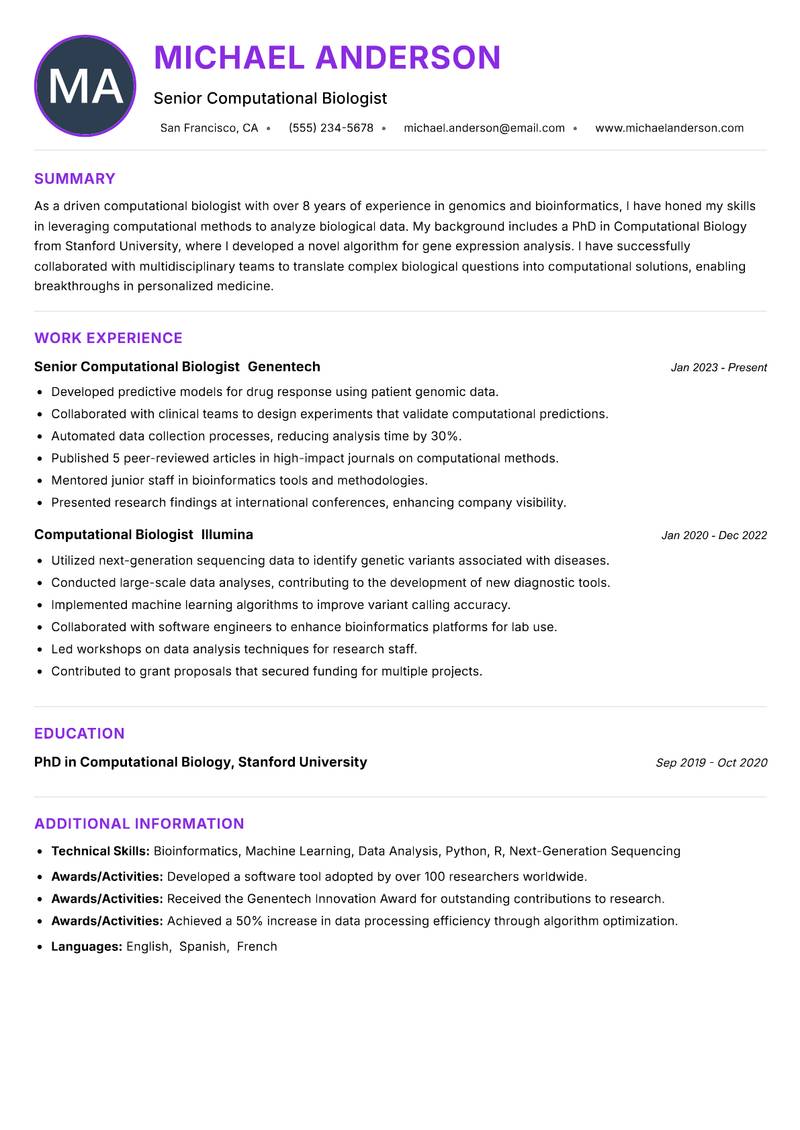
As a driven computational biologist with over 8 years of experience in genomics and bioinformatics, I have honed my skills in leveraging computational methods to analyze biological data. My background includes a PhD in Computational Biology from Stanford University, where I developed a novel algorithm for gene expression analysis. I have successfully collaborated with multidisciplinary teams to translate complex biological questions into computational solutions, enabling breakthroughs in personalized medicine. My expertise lies in using machine learning techniques to uncover patterns in large datasets, which has significantly accelerated research timelines in several projects. I am passionate about applying my skills to contribute to innovative research that impacts human health positively. I thrive in dynamic environments and am adept at communicating technical concepts to diverse audiences, making me an invaluable member of any research team.

Bioinformatics Machine Learning Data Analysis Python R Next-Generation Sequencing
  1. Developed predictive models for drug response using patient genomic data.
  2. Collaborated with clinical teams to design experiments that validate computational predictions.
  3. Automated data collection processes, reducing analysis time by 30%.
  4. Published 5 peer-reviewed articles in high-impact journals on computational methods.
  5. Mentored junior staff in bioinformatics tools and methodologies.
  6. Presented research findings at international conferences, enhancing company visibility.
  1. Utilized next-generation sequencing data to identify genetic variants associated with diseases.
  2. Conducted large-scale data analyses, contributing to the development of new diagnostic tools.
  3. Implemented machine learning algorithms to improve variant calling accuracy.
  4. Collaborated with software engineers to enhance bioinformatics platforms for lab use.
  5. Led workshops on data analysis techniques for research staff.
  6. Contributed to grant proposals that secured funding for multiple projects.

Achievements

  • Developed a software tool adopted by over 100 researchers worldwide.
  • Received the Genentech Innovation Award for outstanding contributions to research.
  • Achieved a 50% increase in data processing efficiency through algorithm optimization.
⏱️
Experience
2-5 Years
📅
Level
Mid Level
🎓
Education
PhD in Computational Biology, ...

Computational Biologist Resume

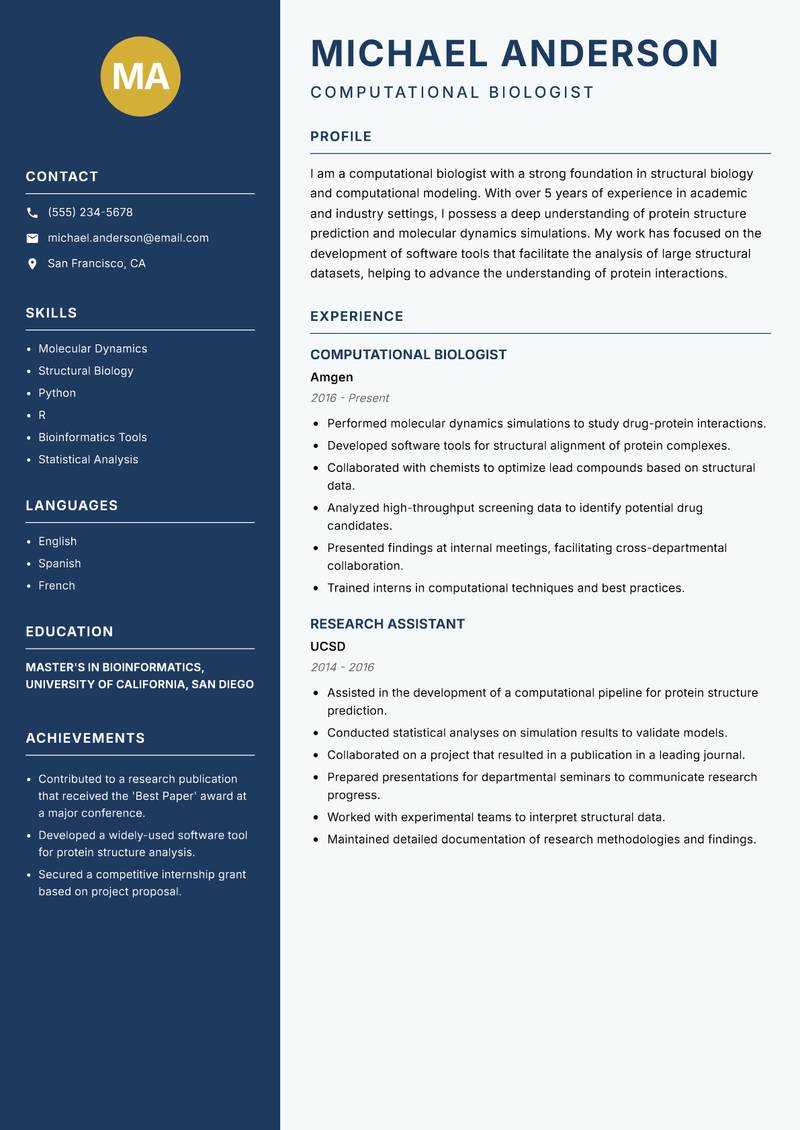
I am a computational biologist with a strong foundation in structural biology and computational modeling. With over 5 years of experience in academic and industry settings, I possess a deep understanding of protein structure prediction and molecular dynamics simulations. My work has focused on the development of software tools that facilitate the analysis of large structural datasets, helping to advance the understanding of protein interactions. I hold a Master's degree in Bioinformatics from the University of California, San Diego, and I have a proven track record of successfully collaborating with experimental biologists to validate computational predictions. I am passionate about integrating computational techniques into biological research to drive innovation and discovery.

Molecular Dynamics Structural Biology Python R Bioinformatics Tools Statistical Analysis
  1. Performed molecular dynamics simulations to study drug-protein interactions.
  2. Developed software tools for structural alignment of protein complexes.
  3. Collaborated with chemists to optimize lead compounds based on structural data.
  4. Analyzed high-throughput screening data to identify potential drug candidates.
  5. Presented findings at internal meetings, facilitating cross-departmental collaboration.
  6. Trained interns in computational techniques and best practices.
  1. Assisted in the development of a computational pipeline for protein structure prediction.
  2. Conducted statistical analyses on simulation results to validate models.
  3. Collaborated on a project that resulted in a publication in a leading journal.
  4. Prepared presentations for departmental seminars to communicate research progress.
  5. Worked with experimental teams to interpret structural data.
  6. Maintained detailed documentation of research methodologies and findings.

Achievements

  • Contributed to a research publication that received the 'Best Paper' award at a major conference.
  • Developed a widely-used software tool for protein structure analysis.
  • Secured a competitive internship grant based on project proposal.
⏱️
Experience
2-5 Years
📅
Level
Mid Level
🎓
Education
Master's in Bioinformatics, Un...

Lead Computational Biologist Resume

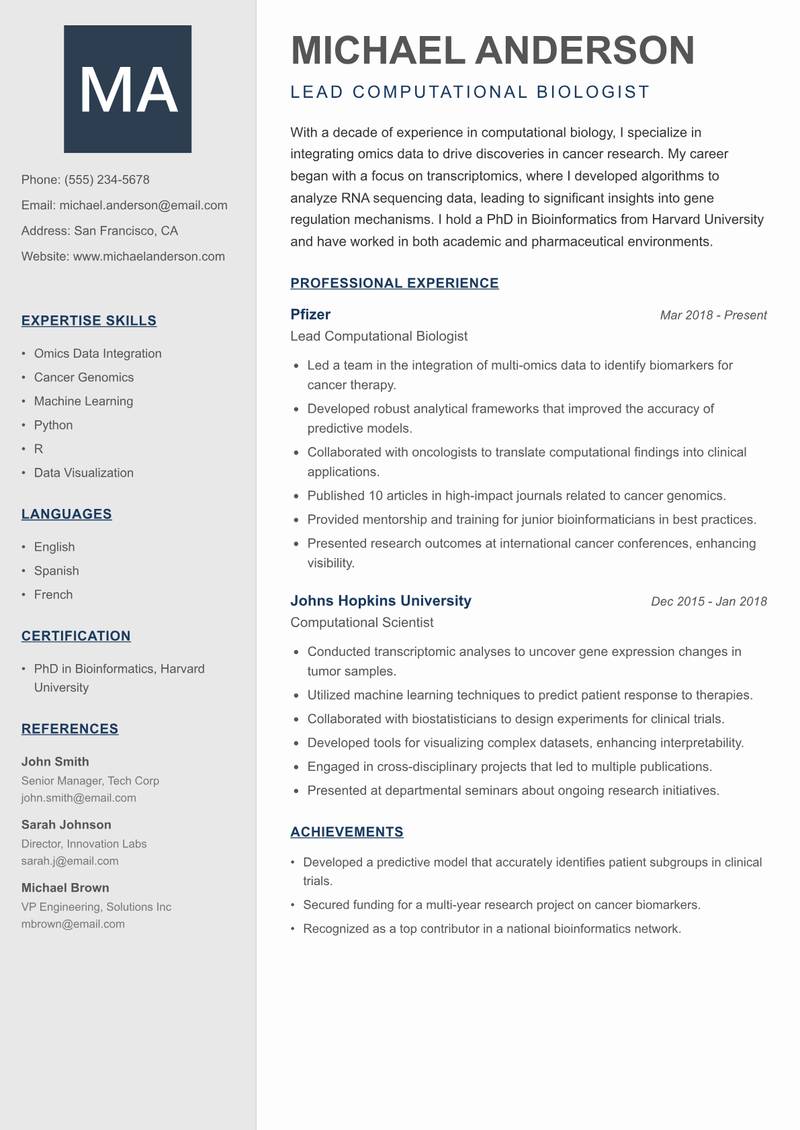
With a decade of experience in computational biology, I specialize in integrating omics data to drive discoveries in cancer research. My career began with a focus on transcriptomics, where I developed algorithms to analyze RNA sequencing data, leading to significant insights into gene regulation mechanisms. I hold a PhD in Bioinformatics from Harvard University and have worked in both academic and pharmaceutical environments. My expertise extends to systems biology, where I model complex biological systems to predict outcomes of therapeutic interventions. I am committed to advancing personalized medicine through data-driven insights and have a strong publication record in top-tier journals.

Omics Data Integration Cancer Genomics Machine Learning Python R Data Visualization
  1. Led a team in the integration of multi-omics data to identify biomarkers for cancer therapy.
  2. Developed robust analytical frameworks that improved the accuracy of predictive models.
  3. Collaborated with oncologists to translate computational findings into clinical applications.
  4. Published 10 articles in high-impact journals related to cancer genomics.
  5. Provided mentorship and training for junior bioinformaticians in best practices.
  6. Presented research outcomes at international cancer conferences, enhancing visibility.
  1. Conducted transcriptomic analyses to uncover gene expression changes in tumor samples.
  2. Utilized machine learning techniques to predict patient response to therapies.
  3. Collaborated with biostatisticians to design experiments for clinical trials.
  4. Developed tools for visualizing complex datasets, enhancing interpretability.
  5. Engaged in cross-disciplinary projects that led to multiple publications.
  6. Presented at departmental seminars about ongoing research initiatives.

Achievements

  • Developed a predictive model that accurately identifies patient subgroups in clinical trials.
  • Secured funding for a multi-year research project on cancer biomarkers.
  • Recognized as a top contributor in a national bioinformatics network.
⏱️
Experience
2-5 Years
📅
Level
Mid Level
🎓
Education
PhD in Bioinformatics, Harvard...

Computational Biologist Resume

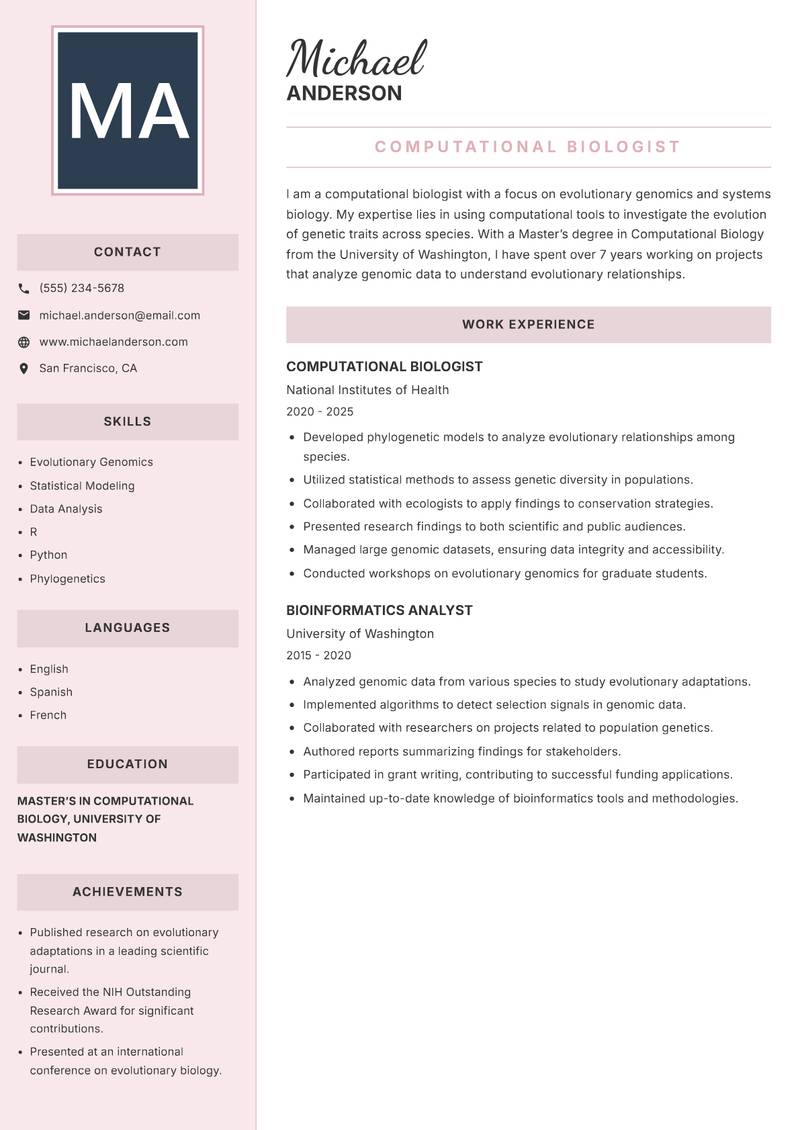
I am a computational biologist with a focus on evolutionary genomics and systems biology. My expertise lies in using computational tools to investigate the evolution of genetic traits across species. With a Master’s degree in Computational Biology from the University of Washington, I have spent over 7 years working on projects that analyze genomic data to understand evolutionary relationships. My goal is to combine computational methods with biological insights to elucidate the mechanisms driving evolution. I am well-versed in statistical modeling and have a strong foundation in programming languages essential for data analysis.

Evolutionary Genomics Statistical Modeling Data Analysis R Python Phylogenetics
  1. Developed phylogenetic models to analyze evolutionary relationships among species.
  2. Utilized statistical methods to assess genetic diversity in populations.
  3. Collaborated with ecologists to apply findings to conservation strategies.
  4. Presented research findings to both scientific and public audiences.
  5. Managed large genomic datasets, ensuring data integrity and accessibility.
  6. Conducted workshops on evolutionary genomics for graduate students.
  1. Analyzed genomic data from various species to study evolutionary adaptations.
  2. Implemented algorithms to detect selection signals in genomic data.
  3. Collaborated with researchers on projects related to population genetics.
  4. Authored reports summarizing findings for stakeholders.
  5. Participated in grant writing, contributing to successful funding applications.
  6. Maintained up-to-date knowledge of bioinformatics tools and methodologies.

Achievements

  • Published research on evolutionary adaptations in a leading scientific journal.
  • Received the NIH Outstanding Research Award for significant contributions.
  • Presented at an international conference on evolutionary biology.
⏱️
Experience
2-5 Years
📅
Level
Mid Level
🎓
Education
Master’s in Computational Bi...

Computational Biologist Resume

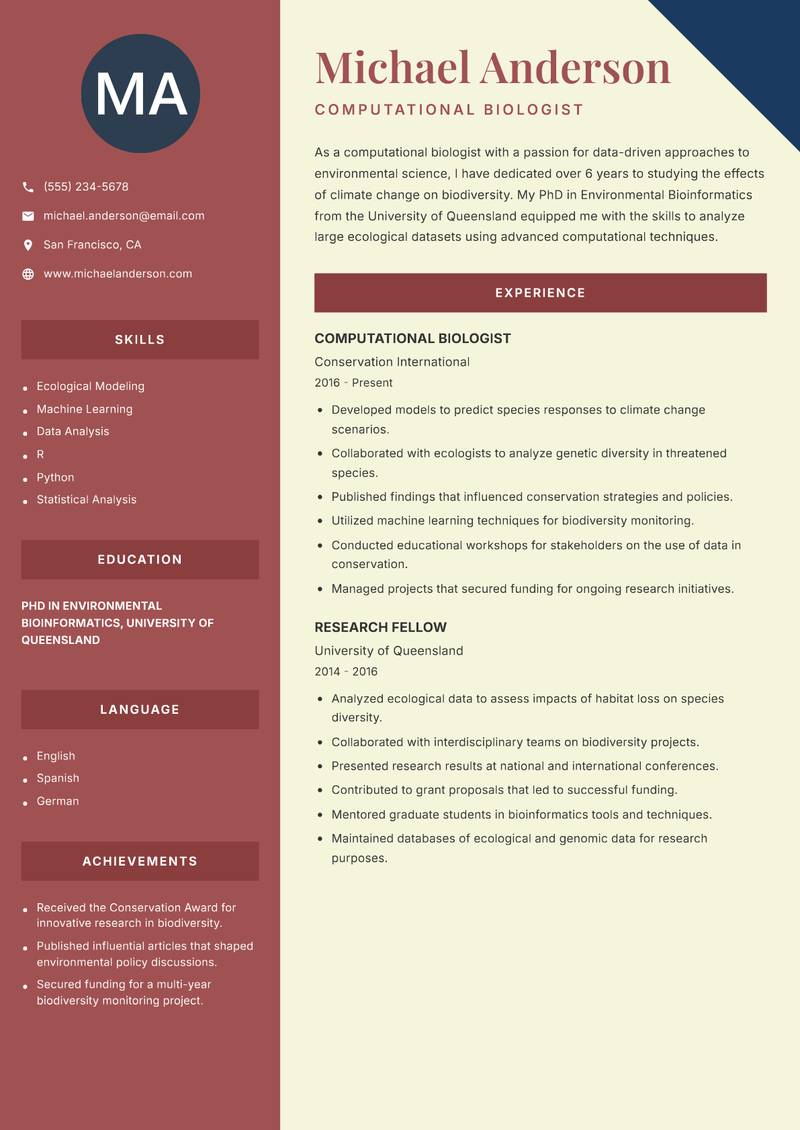
As a computational biologist with a passion for data-driven approaches to environmental science, I have dedicated over 6 years to studying the effects of climate change on biodiversity. My PhD in Environmental Bioinformatics from the University of Queensland equipped me with the skills to analyze large ecological datasets using advanced computational techniques. I have worked on interdisciplinary teams to assess the impacts of environmental changes on genetic diversity in various species. My goal is to leverage computational biology to inform conservation efforts and policy-making. I have a robust background in machine learning and statistical analysis, which I utilize to derive insights from complex datasets.

Ecological Modeling Machine Learning Data Analysis R Python Statistical Analysis
  1. Developed models to predict species responses to climate change scenarios.
  2. Collaborated with ecologists to analyze genetic diversity in threatened species.
  3. Published findings that influenced conservation strategies and policies.
  4. Utilized machine learning techniques for biodiversity monitoring.
  5. Conducted educational workshops for stakeholders on the use of data in conservation.
  6. Managed projects that secured funding for ongoing research initiatives.
  1. Analyzed ecological data to assess impacts of habitat loss on species diversity.
  2. Collaborated with interdisciplinary teams on biodiversity projects.
  3. Presented research results at national and international conferences.
  4. Contributed to grant proposals that led to successful funding.
  5. Mentored graduate students in bioinformatics tools and techniques.
  6. Maintained databases of ecological and genomic data for research purposes.

Achievements

  • Received the Conservation Award for innovative research in biodiversity.
  • Published influential articles that shaped environmental policy discussions.
  • Secured funding for a multi-year biodiversity monitoring project.
⏱️
Experience
2-5 Years
📅
Level
Mid Level
🎓
Education
PhD in Environmental Bioinform...

Computational Biologist Resume

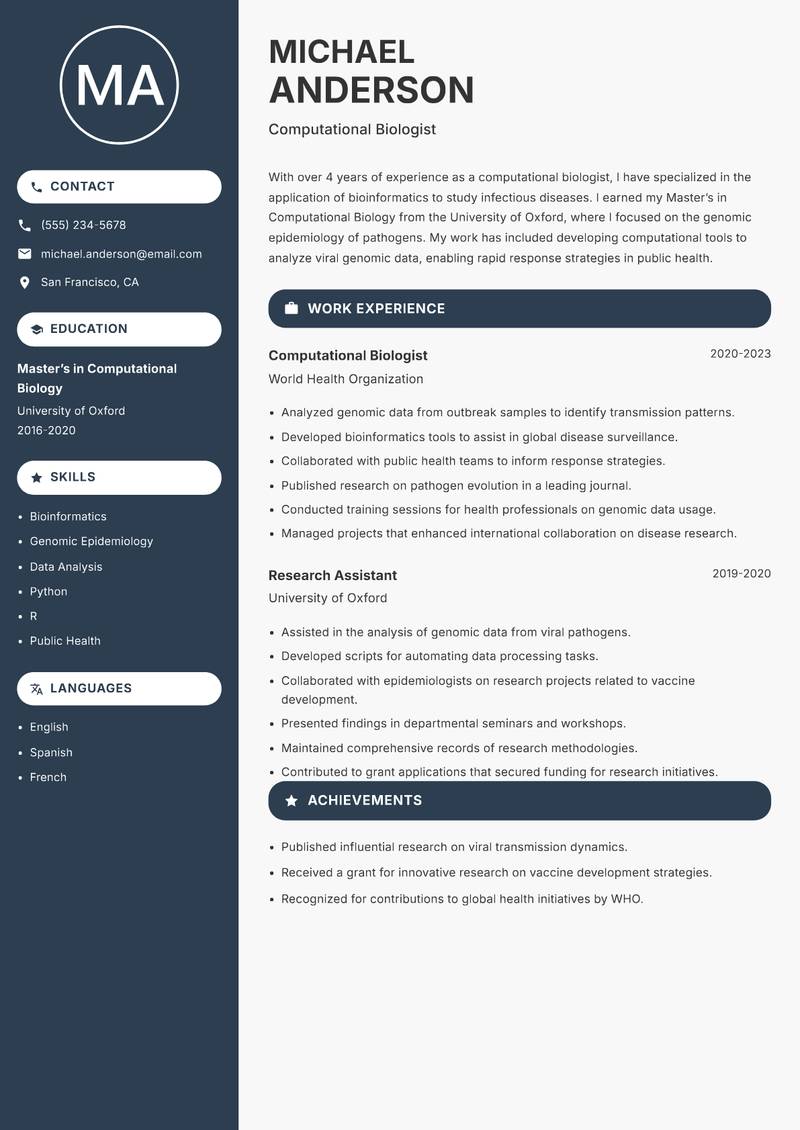
With over 4 years of experience as a computational biologist, I have specialized in the application of bioinformatics to study infectious diseases. I earned my Master’s in Computational Biology from the University of Oxford, where I focused on the genomic epidemiology of pathogens. My work has included developing computational tools to analyze viral genomic data, enabling rapid response strategies in public health. I am dedicated to using my skills to drive innovations in disease research and contribute to global health initiatives. My strong analytical skills and proficiency in various programming languages allow me to address complex biological questions effectively.

Bioinformatics Genomic Epidemiology Data Analysis Python R Public Health
  1. Analyzed genomic data from outbreak samples to identify transmission patterns.
  2. Developed bioinformatics tools to assist in global disease surveillance.
  3. Collaborated with public health teams to inform response strategies.
  4. Published research on pathogen evolution in a leading journal.
  5. Conducted training sessions for health professionals on genomic data usage.
  6. Managed projects that enhanced international collaboration on disease research.
  1. Assisted in the analysis of genomic data from viral pathogens.
  2. Developed scripts for automating data processing tasks.
  3. Collaborated with epidemiologists on research projects related to vaccine development.
  4. Presented findings in departmental seminars and workshops.
  5. Maintained comprehensive records of research methodologies.
  6. Contributed to grant applications that secured funding for research initiatives.

Achievements

  • Published influential research on viral transmission dynamics.
  • Received a grant for innovative research on vaccine development strategies.
  • Recognized for contributions to global health initiatives by WHO.
⏱️
Experience
2-5 Years
📅
Level
Mid Level
🎓
Education
Master’s in Computational Bi...

Computational Biologist Resume

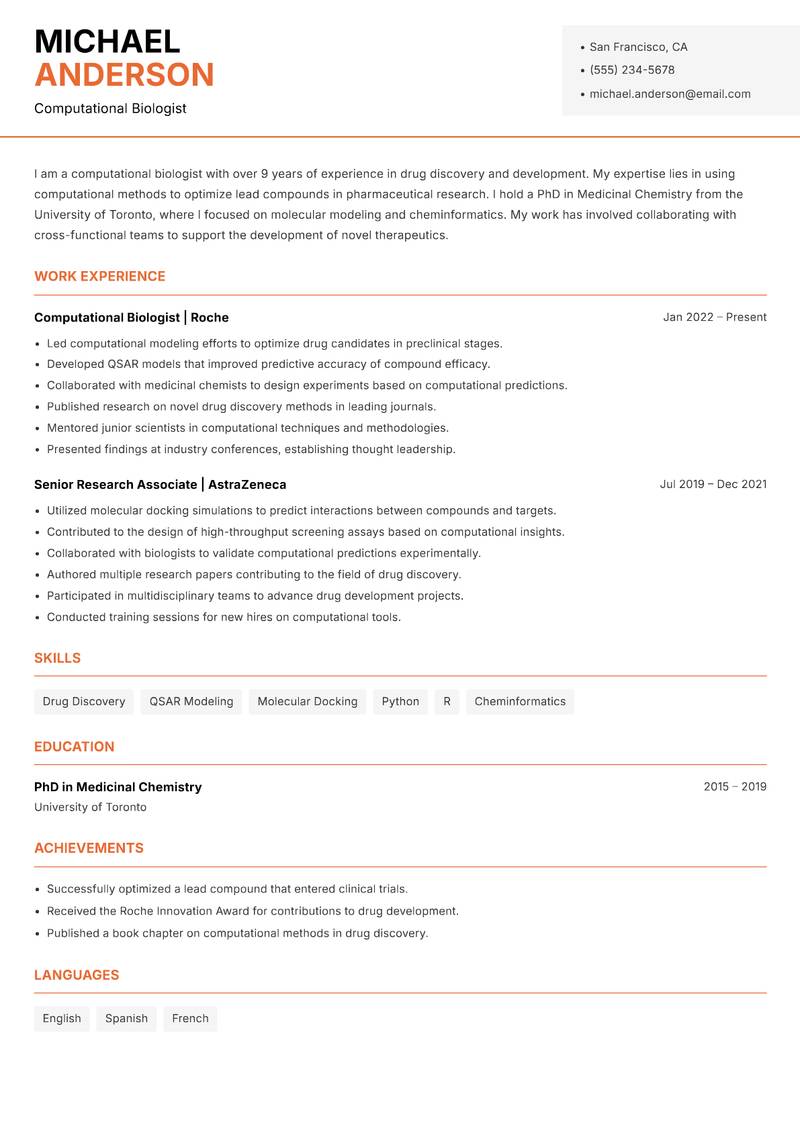
I am a computational biologist with over 9 years of experience in drug discovery and development. My expertise lies in using computational methods to optimize lead compounds in pharmaceutical research. I hold a PhD in Medicinal Chemistry from the University of Toronto, where I focused on molecular modeling and cheminformatics. My work has involved collaborating with cross-functional teams to support the development of novel therapeutics. I am skilled in applying quantitative structure-activity relationship (QSAR) modeling and molecular docking techniques to enhance compound efficacy. I am committed to advancing drug discovery processes through innovative computational strategies.

Drug Discovery QSAR Modeling Molecular Docking Python R Cheminformatics
  1. Led computational modeling efforts to optimize drug candidates in preclinical stages.
  2. Developed QSAR models that improved predictive accuracy of compound efficacy.
  3. Collaborated with medicinal chemists to design experiments based on computational predictions.
  4. Published research on novel drug discovery methods in leading journals.
  5. Mentored junior scientists in computational techniques and methodologies.
  6. Presented findings at industry conferences, establishing thought leadership.
  1. Utilized molecular docking simulations to predict interactions between compounds and targets.
  2. Contributed to the design of high-throughput screening assays based on computational insights.
  3. Collaborated with biologists to validate computational predictions experimentally.
  4. Authored multiple research papers contributing to the field of drug discovery.
  5. Participated in multidisciplinary teams to advance drug development projects.
  6. Conducted training sessions for new hires on computational tools.

Achievements

  • Successfully optimized a lead compound that entered clinical trials.
  • Received the Roche Innovation Award for contributions to drug development.
  • Published a book chapter on computational methods in drug discovery.
⏱️
Experience
2-5 Years
📅
Level
Mid Level
🎓
Education
PhD in Medicinal Chemistry, Un...

Key Skills for Computational Biologist Positions

Successful computational biologist professionals typically possess a combination of technical expertise, soft skills, and industry knowledge. Common skills include problem-solving abilities, attention to detail, communication skills, and proficiency in relevant tools and technologies specific to the role.

Typical Responsibilities

Computational Biologist roles often involve a range of responsibilities that may include project management, collaboration with cross-functional teams, meeting deadlines, maintaining quality standards, and contributing to organizational goals. Specific duties vary by company and seniority level.

Resume Tips for Computational Biologist Applications

ATS Optimization

Applicant Tracking Systems (ATS) scan resumes for keywords and formatting. To optimize your computational biologist resume for ATS:

Frequently Asked Questions

How do I customize this computational biologist resume template?

You can customize this resume template by replacing the placeholder content with your own information. Update the professional summary, work experience, education, and skills sections to match your background. Ensure all dates, company names, and achievements are accurate and relevant to your career history.

Is this computational biologist resume template ATS-friendly?

Yes, this resume template is designed to be ATS-friendly. It uses standard section headings, clear formatting, and avoids complex graphics or tables that can confuse applicant tracking systems. The structure follows best practices for ATS compatibility, making it easier for your resume to be parsed correctly by automated systems.

What is the ideal length for a computational biologist resume?

For most computational biologist positions, a one to two-page resume is ideal. Entry-level candidates should aim for one page, while experienced professionals with extensive work history may use two pages. Focus on the most relevant and recent experience, and ensure every section adds value to your application.

How should I format my computational biologist resume for best results?

Use a clean, professional format with consistent fonts and spacing. Include standard sections such as Contact Information, Professional Summary, Work Experience, Education, and Skills. Use bullet points for easy scanning, and ensure your contact information is clearly visible at the top. Save your resume as a PDF to preserve formatting across different devices and systems.

Can I use this template for different computational biologist job applications?

Yes, you can use this template as a base for multiple applications. However, it's recommended to tailor your resume for each specific job posting. Review the job description carefully and incorporate relevant keywords, skills, and experiences that match the requirements. Customizing your resume for each application increases your chances of passing ATS filters and catching the attention of hiring managers.

Scroll to view samples