Coastal Fisheries Specialist Resume

As a Coastal Fisheries Specialist, you will be responsible for conducting comprehensive assessments of coastal fish stocks and their habitats. You will analyze data to inform sustainable fishing practices and work closely with local communities to ensure their fishing activities align with conservation goals. Your expertise will be crucial in developing policies that promote the health of marine ecosystems while supporting local economies. In this role, you will collaborate with government agencies, non-profit organizations, and academic institutions to implement effective fisheries management strategies. You will lead outreach efforts to educate the public on the importance of sustainable fishing and engage with stakeholders to address challenges faced by coastal fisheries. Your work will directly contribute to the preservation of biodiversity and the resilience of coastal communities.

0.0 (0 ratings)

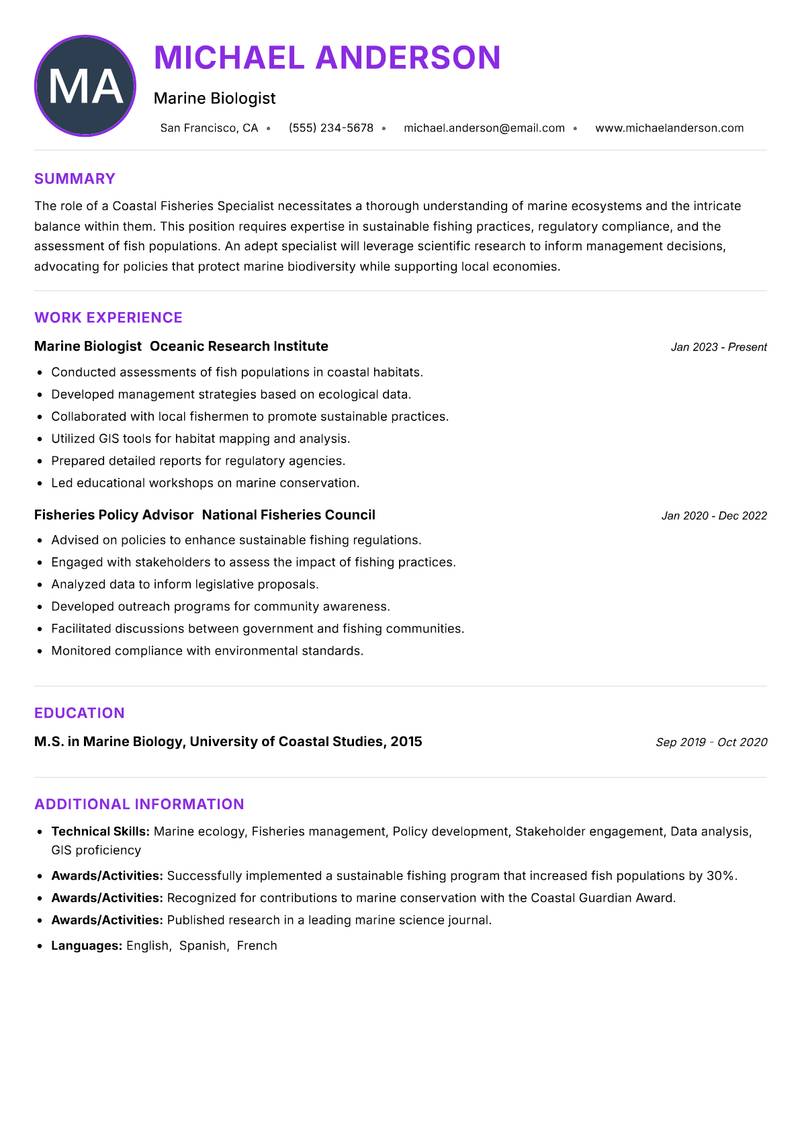
Marine Biologist Resume

The role of a Coastal Fisheries Specialist necessitates a thorough understanding of marine ecosystems and the intricate balance within them. This position requires expertise in sustainable fishing practices, regulatory compliance, and the assessment of fish populations. An adept specialist will leverage scientific research to inform management decisions, advocating for policies that protect marine biodiversity while supporting local economies. Collaboration with stakeholders, including governmental agencies, NGOs, and fishing communities, is vital for the formulation of effective conservation strategies. A successful career in this field is marked by a dedication to advancing sustainable fisheries management, ensuring the resilience of coastal ecosystems for future generations. Furthermore, the ability to communicate complex scientific data to varied audiences is crucial for fostering community engagement and promoting the importance of marine conservation initiatives.

Marine ecology Fisheries management Policy development Stakeholder engagement Data analysis GIS proficiency
  1. Conducted assessments of fish populations in coastal habitats.
  2. Developed management strategies based on ecological data.
  3. Collaborated with local fishermen to promote sustainable practices.
  4. Utilized GIS tools for habitat mapping and analysis.
  5. Prepared detailed reports for regulatory agencies.
  6. Led educational workshops on marine conservation.
  1. Advised on policies to enhance sustainable fishing regulations.
  2. Engaged with stakeholders to assess the impact of fishing practices.
  3. Analyzed data to inform legislative proposals.
  4. Developed outreach programs for community awareness.
  5. Facilitated discussions between government and fishing communities.
  6. Monitored compliance with environmental standards.

Achievements

  • Successfully implemented a sustainable fishing program that increased fish populations by 30%.
  • Recognized for contributions to marine conservation with the Coastal Guardian Award.
  • Published research in a leading marine science journal.
⏱️
Experience
2-5 Years
📅
Level
Mid Level
🎓
Education
M.S. in Marine Biology, Univer...

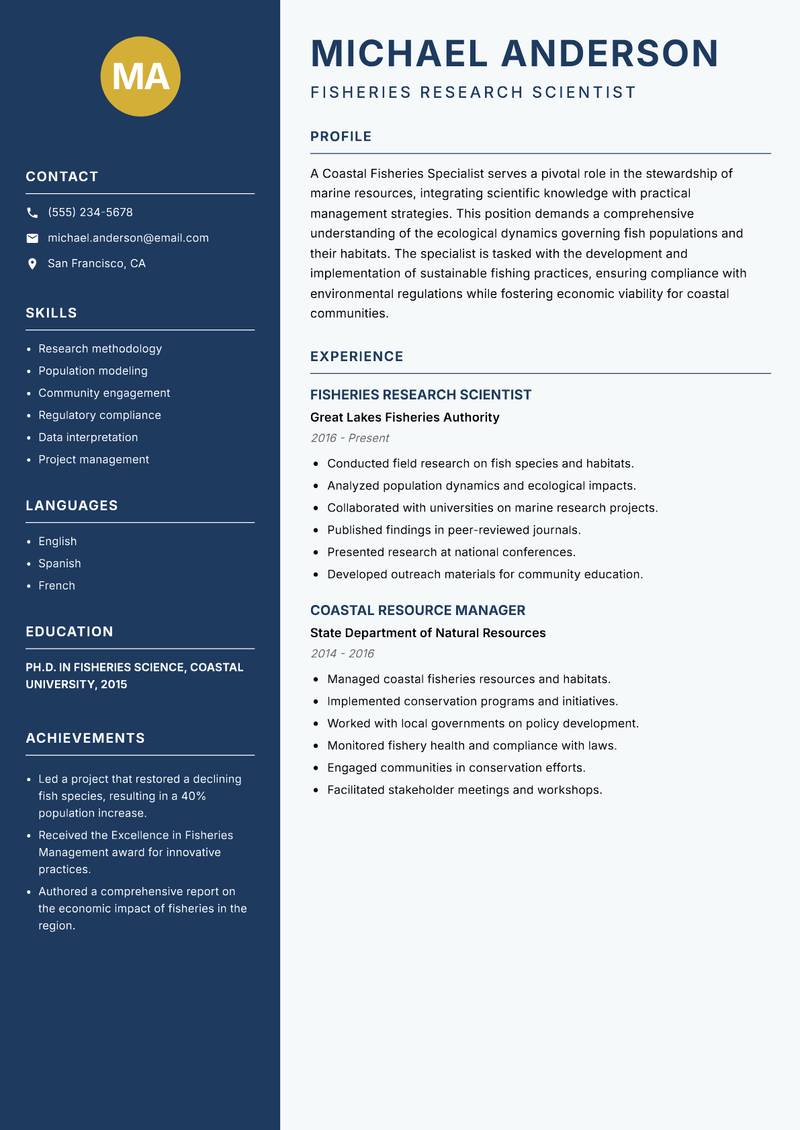
Fisheries Research Scientist Resume

A Coastal Fisheries Specialist serves a pivotal role in the stewardship of marine resources, integrating scientific knowledge with practical management strategies. This position demands a comprehensive understanding of the ecological dynamics governing fish populations and their habitats. The specialist is tasked with the development and implementation of sustainable fishing practices, ensuring compliance with environmental regulations while fostering economic viability for coastal communities. The effective management of fisheries requires not only technical expertise but also the ability to communicate effectively with diverse stakeholders. Emphasizing collaborative approaches and stakeholder engagement is essential for achieving long-term conservation goals. A successful specialist will demonstrate a commitment to the sustainable use of marine resources, contributing to the resilience of coastal ecosystems in the face of climate change and overfishing.

Research methodology Population modeling Community engagement Regulatory compliance Data interpretation Project management
  1. Conducted field research on fish species and habitats.
  2. Analyzed population dynamics and ecological impacts.
  3. Collaborated with universities on marine research projects.
  4. Published findings in peer-reviewed journals.
  5. Presented research at national conferences.
  6. Developed outreach materials for community education.
  1. Managed coastal fisheries resources and habitats.
  2. Implemented conservation programs and initiatives.
  3. Worked with local governments on policy development.
  4. Monitored fishery health and compliance with laws.
  5. Engaged communities in conservation efforts.
  6. Facilitated stakeholder meetings and workshops.

Achievements

  • Led a project that restored a declining fish species, resulting in a 40% population increase.
  • Received the Excellence in Fisheries Management award for innovative practices.
  • Authored a comprehensive report on the economic impact of fisheries in the region.
⏱️
Experience
2-5 Years
📅
Level
Mid Level
🎓
Education
Ph.D. in Fisheries Science, Co...

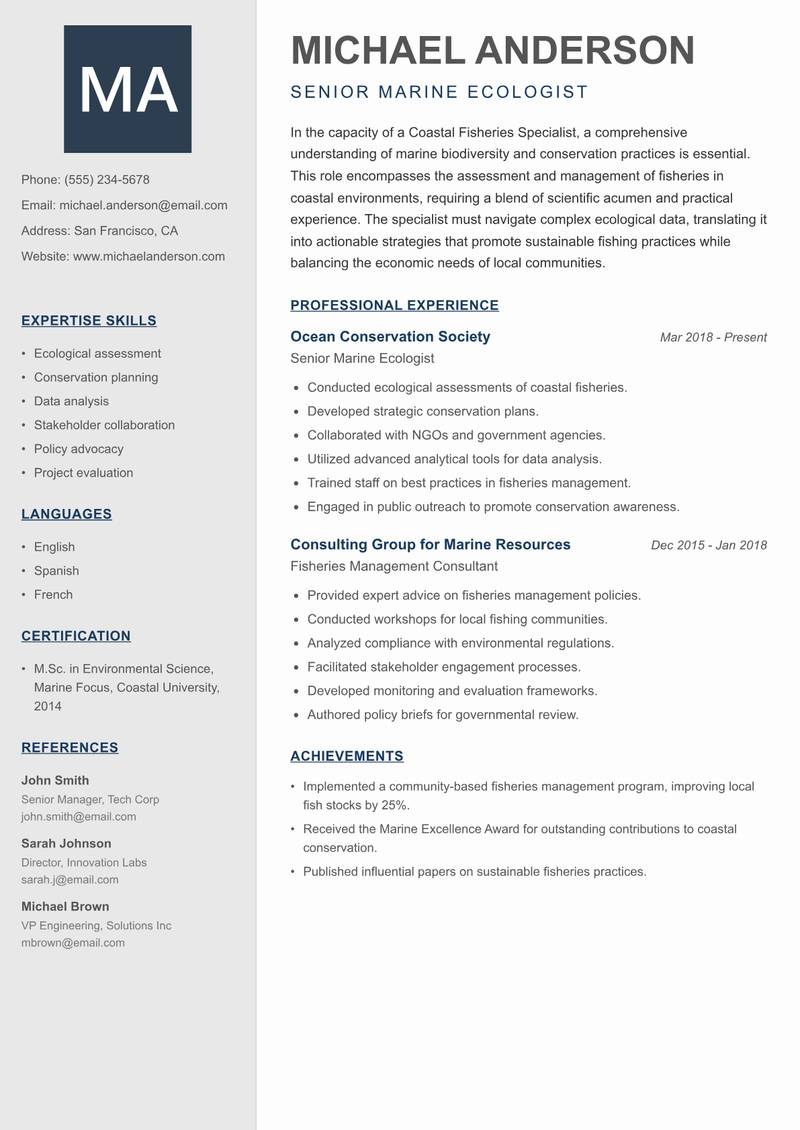
Senior Marine Ecologist Resume

In the capacity of a Coastal Fisheries Specialist, a comprehensive understanding of marine biodiversity and conservation practices is essential. This role encompasses the assessment and management of fisheries in coastal environments, requiring a blend of scientific acumen and practical experience. The specialist must navigate complex ecological data, translating it into actionable strategies that promote sustainable fishing practices while balancing the economic needs of local communities. Effective communication and collaboration with various stakeholders are paramount for fostering a shared vision of marine resource stewardship. A demonstrated commitment to advancing sustainable practices and protecting marine ecosystems is fundamental to this career path, ensuring the resilience of coastal fisheries amidst growing environmental challenges. The ability to advocate for science-based policies will be crucial in shaping the future of coastal fisheries management.

Ecological assessment Conservation planning Data analysis Stakeholder collaboration Policy advocacy Project evaluation
  1. Conducted ecological assessments of coastal fisheries.
  2. Developed strategic conservation plans.
  3. Collaborated with NGOs and government agencies.
  4. Utilized advanced analytical tools for data analysis.
  5. Trained staff on best practices in fisheries management.
  6. Engaged in public outreach to promote conservation awareness.
  1. Provided expert advice on fisheries management policies.
  2. Conducted workshops for local fishing communities.
  3. Analyzed compliance with environmental regulations.
  4. Facilitated stakeholder engagement processes.
  5. Developed monitoring and evaluation frameworks.
  6. Authored policy briefs for governmental review.

Achievements

  • Implemented a community-based fisheries management program, improving local fish stocks by 25%.
  • Received the Marine Excellence Award for outstanding contributions to coastal conservation.
  • Published influential papers on sustainable fisheries practices.
⏱️
Experience
2-5 Years
📅
Level
Mid Level
🎓
Education
M.Sc. in Environmental Science...

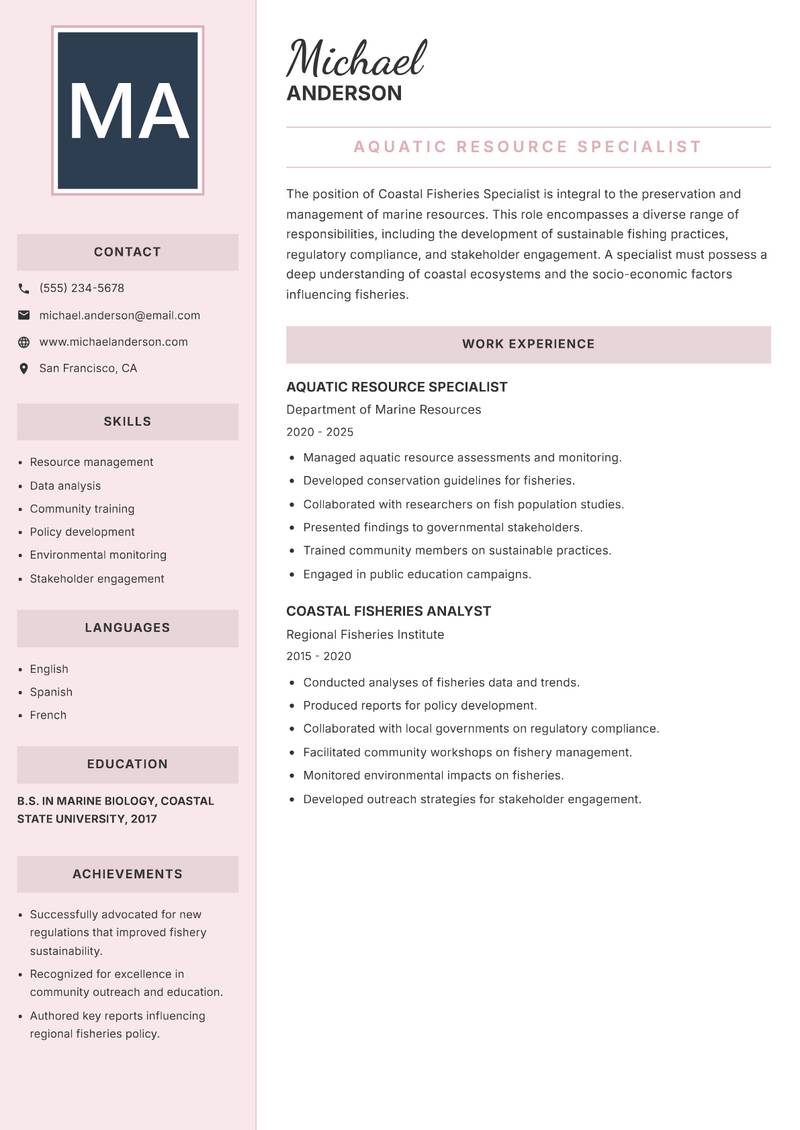
Aquatic Resource Specialist Resume

The position of Coastal Fisheries Specialist is integral to the preservation and management of marine resources. This role encompasses a diverse range of responsibilities, including the development of sustainable fishing practices, regulatory compliance, and stakeholder engagement. A specialist must possess a deep understanding of coastal ecosystems and the socio-economic factors influencing fisheries. The ability to analyze complex data and translate findings into effective management strategies is essential. Moreover, fostering relationships with local communities and stakeholders is crucial for the successful implementation of conservation initiatives. A commitment to sustainability and the promotion of marine biodiversity underpins this career. The specialist's efforts will play a significant role in ensuring the viability of coastal fisheries for future generations, contributing to both ecological health and economic stability.

Resource management Data analysis Community training Policy development Environmental monitoring Stakeholder engagement
  1. Managed aquatic resource assessments and monitoring.
  2. Developed conservation guidelines for fisheries.
  3. Collaborated with researchers on fish population studies.
  4. Presented findings to governmental stakeholders.
  5. Trained community members on sustainable practices.
  6. Engaged in public education campaigns.
  1. Conducted analyses of fisheries data and trends.
  2. Produced reports for policy development.
  3. Collaborated with local governments on regulatory compliance.
  4. Facilitated community workshops on fishery management.
  5. Monitored environmental impacts on fisheries.
  6. Developed outreach strategies for stakeholder engagement.

Achievements

  • Successfully advocated for new regulations that improved fishery sustainability.
  • Recognized for excellence in community outreach and education.
  • Authored key reports influencing regional fisheries policy.
⏱️
Experience
2-5 Years
📅
Level
Mid Level
🎓
Education
B.S. in Marine Biology, Coasta...

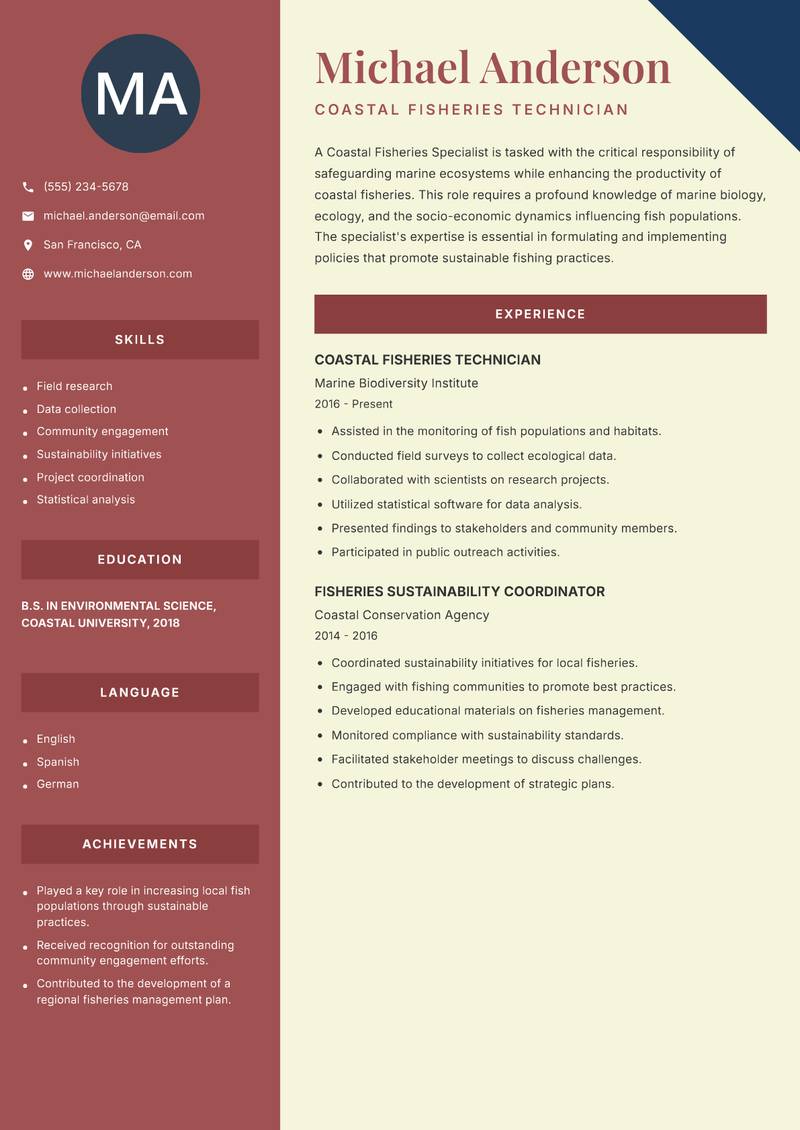
Coastal Fisheries Technician Resume

A Coastal Fisheries Specialist is tasked with the critical responsibility of safeguarding marine ecosystems while enhancing the productivity of coastal fisheries. This role requires a profound knowledge of marine biology, ecology, and the socio-economic dynamics influencing fish populations. The specialist's expertise is essential in formulating and implementing policies that promote sustainable fishing practices. A successful career in this field hinges on the ability to collaborate with a myriad of stakeholders, including local communities, governmental bodies, and environmental organizations. Through effective communication and advocacy, the specialist fosters a shared commitment to marine conservation. The integration of scientific research into practical management strategies is paramount, ensuring that fisheries remain viable while preserving the integrity of marine habitats for future generations. A dedication to continuous learning and adaptation in response to environmental changes is essential for success in this role.

Field research Data collection Community engagement Sustainability initiatives Project coordination Statistical analysis
  1. Assisted in the monitoring of fish populations and habitats.
  2. Conducted field surveys to collect ecological data.
  3. Collaborated with scientists on research projects.
  4. Utilized statistical software for data analysis.
  5. Presented findings to stakeholders and community members.
  6. Participated in public outreach activities.
  1. Coordinated sustainability initiatives for local fisheries.
  2. Engaged with fishing communities to promote best practices.
  3. Developed educational materials on fisheries management.
  4. Monitored compliance with sustainability standards.
  5. Facilitated stakeholder meetings to discuss challenges.
  6. Contributed to the development of strategic plans.

Achievements

  • Played a key role in increasing local fish populations through sustainable practices.
  • Received recognition for outstanding community engagement efforts.
  • Contributed to the development of a regional fisheries management plan.
⏱️
Experience
2-5 Years
📅
Level
Mid Level
🎓
Education
B.S. in Environmental Science,...

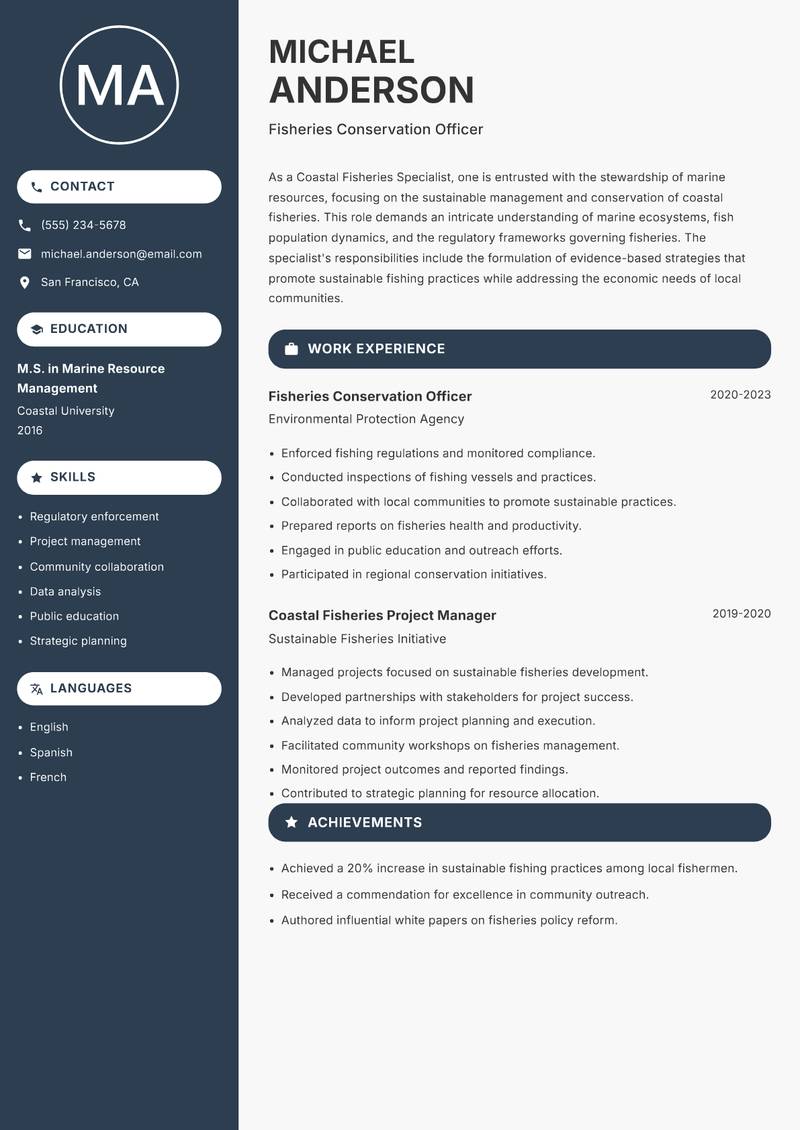
Fisheries Conservation Officer Resume

As a Coastal Fisheries Specialist, one is entrusted with the stewardship of marine resources, focusing on the sustainable management and conservation of coastal fisheries. This role demands an intricate understanding of marine ecosystems, fish population dynamics, and the regulatory frameworks governing fisheries. The specialist's responsibilities include the formulation of evidence-based strategies that promote sustainable fishing practices while addressing the economic needs of local communities. Successful execution of these strategies requires collaboration with diverse stakeholders, including governmental agencies, non-profit organizations, and local fishermen. The ability to communicate complex scientific concepts effectively is critical for fostering community support and engagement in conservation initiatives. A commitment to continuous improvement and adaptation to environmental changes is essential for ensuring the long-term viability of coastal fisheries. This career path not only contributes to ecological health but also supports the livelihoods of those who depend on marine resources.

Regulatory enforcement Project management Community collaboration Data analysis Public education Strategic planning
  1. Enforced fishing regulations and monitored compliance.
  2. Conducted inspections of fishing vessels and practices.
  3. Collaborated with local communities to promote sustainable practices.
  4. Prepared reports on fisheries health and productivity.
  5. Engaged in public education and outreach efforts.
  6. Participated in regional conservation initiatives.
  1. Managed projects focused on sustainable fisheries development.
  2. Developed partnerships with stakeholders for project success.
  3. Analyzed data to inform project planning and execution.
  4. Facilitated community workshops on fisheries management.
  5. Monitored project outcomes and reported findings.
  6. Contributed to strategic planning for resource allocation.

Achievements

  • Achieved a 20% increase in sustainable fishing practices among local fishermen.
  • Received a commendation for excellence in community outreach.
  • Authored influential white papers on fisheries policy reform.
⏱️
Experience
2-5 Years
📅
Level
Mid Level
🎓
Education
M.S. in Marine Resource Manage...

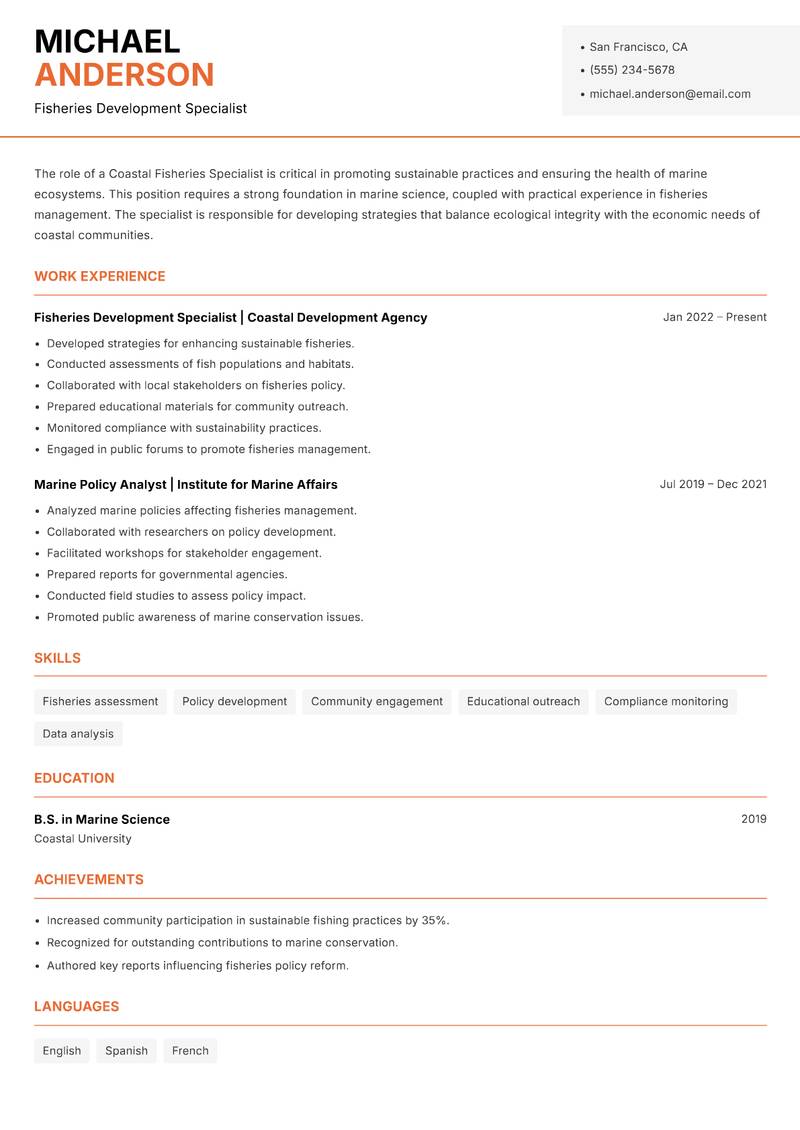
Fisheries Development Specialist Resume

The role of a Coastal Fisheries Specialist is critical in promoting sustainable practices and ensuring the health of marine ecosystems. This position requires a strong foundation in marine science, coupled with practical experience in fisheries management. The specialist is responsible for developing strategies that balance ecological integrity with the economic needs of coastal communities. Effective stakeholder engagement and communication are essential for fostering collaboration among various interest groups. A successful career in this field is characterized by a commitment to advancing marine conservation efforts and advocating for science-based policies. By integrating research and community input, the specialist contributes to the long-term viability of coastal fisheries, ensuring that these resources are available for future generations. Continuous adaptation to environmental changes and challenges is vital for maintaining the resilience of marine ecosystems.

Fisheries assessment Policy development Community engagement Educational outreach Compliance monitoring Data analysis
  1. Developed strategies for enhancing sustainable fisheries.
  2. Conducted assessments of fish populations and habitats.
  3. Collaborated with local stakeholders on fisheries policy.
  4. Prepared educational materials for community outreach.
  5. Monitored compliance with sustainability practices.
  6. Engaged in public forums to promote fisheries management.
  1. Analyzed marine policies affecting fisheries management.
  2. Collaborated with researchers on policy development.
  3. Facilitated workshops for stakeholder engagement.
  4. Prepared reports for governmental agencies.
  5. Conducted field studies to assess policy impact.
  6. Promoted public awareness of marine conservation issues.

Achievements

  • Increased community participation in sustainable fishing practices by 35%.
  • Recognized for outstanding contributions to marine conservation.
  • Authored key reports influencing fisheries policy reform.
⏱️
Experience
2-5 Years
📅
Level
Mid Level
🎓
Education
B.S. in Marine Science, Coasta...

Key Skills for Coastal Fisheries Specialist Positions

Successful coastal fisheries specialist professionals typically possess a combination of technical expertise, soft skills, and industry knowledge. Common skills include problem-solving abilities, attention to detail, communication skills, and proficiency in relevant tools and technologies specific to the role.

Typical Responsibilities

Coastal Fisheries Specialist roles often involve a range of responsibilities that may include project management, collaboration with cross-functional teams, meeting deadlines, maintaining quality standards, and contributing to organizational goals. Specific duties vary by company and seniority level.

Resume Tips for Coastal Fisheries Specialist Applications

ATS Optimization

Applicant Tracking Systems (ATS) scan resumes for keywords and formatting. To optimize your coastal fisheries specialist resume for ATS:

Frequently Asked Questions

How do I customize this coastal fisheries specialist resume template?

You can customize this resume template by replacing the placeholder content with your own information. Update the professional summary, work experience, education, and skills sections to match your background. Ensure all dates, company names, and achievements are accurate and relevant to your career history.

Is this coastal fisheries specialist resume template ATS-friendly?

Yes, this resume template is designed to be ATS-friendly. It uses standard section headings, clear formatting, and avoids complex graphics or tables that can confuse applicant tracking systems. The structure follows best practices for ATS compatibility, making it easier for your resume to be parsed correctly by automated systems.

What is the ideal length for a coastal fisheries specialist resume?

For most coastal fisheries specialist positions, a one to two-page resume is ideal. Entry-level candidates should aim for one page, while experienced professionals with extensive work history may use two pages. Focus on the most relevant and recent experience, and ensure every section adds value to your application.

How should I format my coastal fisheries specialist resume for best results?

Use a clean, professional format with consistent fonts and spacing. Include standard sections such as Contact Information, Professional Summary, Work Experience, Education, and Skills. Use bullet points for easy scanning, and ensure your contact information is clearly visible at the top. Save your resume as a PDF to preserve formatting across different devices and systems.

Can I use this template for different coastal fisheries specialist job applications?

Yes, you can use this template as a base for multiple applications. However, it's recommended to tailor your resume for each specific job posting. Review the job description carefully and incorporate relevant keywords, skills, and experiences that match the requirements. Customizing your resume for each application increases your chances of passing ATS filters and catching the attention of hiring managers.

Scroll to view samples