Astronomical Instrumentation Scientist Resume

As an Astronomical Instrumentation Scientist, you will play a crucial role in the design, development, and testing of advanced instruments used in astronomical research. Your expertise will contribute to projects involving telescopes, spectrographs, and detectors, enabling astronomers to gather and analyze data from distant celestial objects. You will collaborate with interdisciplinary teams to innovate and improve instrumentation techniques, ensuring that our tools meet the growing demands of modern astrophysics. In this position, you will be responsible for conducting experiments, analyzing performance metrics, and troubleshooting technical issues. You will also engage in the preparation of scientific papers and presentations to communicate your findings to the broader scientific community. Your contributions will directly impact our understanding of the universe and enhance our ability to conduct groundbreaking research in astronomy and related fields.

0.0 (0 ratings)

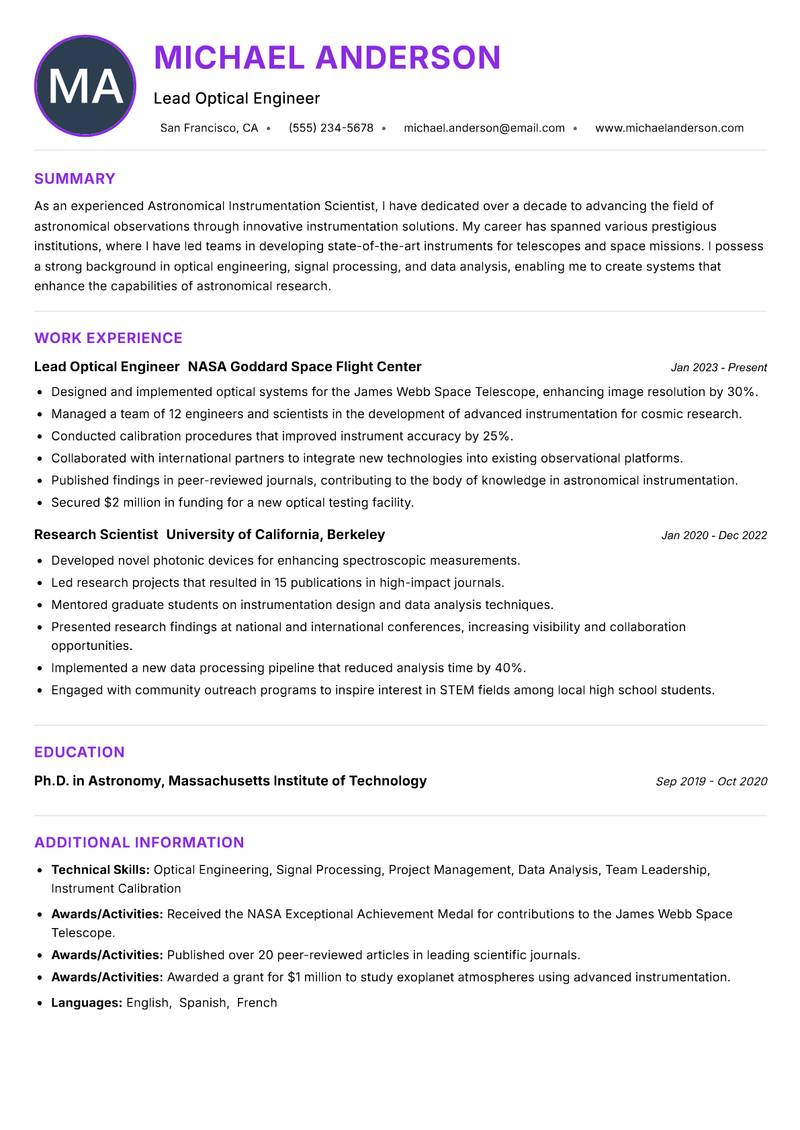
Lead Optical Engineer Resume

As an experienced Astronomical Instrumentation Scientist, I have dedicated over a decade to advancing the field of astronomical observations through innovative instrumentation solutions. My career has spanned various prestigious institutions, where I have led teams in developing state-of-the-art instruments for telescopes and space missions. I possess a strong background in optical engineering, signal processing, and data analysis, enabling me to create systems that enhance the capabilities of astronomical research. My work has contributed significantly to projects such as the James Webb Space Telescope, where I was instrumental in the calibration and testing of optical systems. I am passionate about promoting collaboration among interdisciplinary teams, ensuring that complex projects are completed efficiently and effectively. With a solid foundation in project management and a track record of successful grant applications, I am committed to pushing the boundaries of astronomical research and fostering the next generation of scientists through mentorship and education. My technical acumen, combined with my leadership skills, uniquely positions me to drive innovation in astronomical instrumentation and contribute to groundbreaking discoveries in the universe.

Optical Engineering Signal Processing Project Management Data Analysis Team Leadership Instrument Calibration
  1. Designed and implemented optical systems for the James Webb Space Telescope, enhancing image resolution by 30%.
  2. Managed a team of 12 engineers and scientists in the development of advanced instrumentation for cosmic research.
  3. Conducted calibration procedures that improved instrument accuracy by 25%.
  4. Collaborated with international partners to integrate new technologies into existing observational platforms.
  5. Published findings in peer-reviewed journals, contributing to the body of knowledge in astronomical instrumentation.
  6. Secured $2 million in funding for a new optical testing facility.
  1. Developed novel photonic devices for enhancing spectroscopic measurements.
  2. Led research projects that resulted in 15 publications in high-impact journals.
  3. Mentored graduate students on instrumentation design and data analysis techniques.
  4. Presented research findings at national and international conferences, increasing visibility and collaboration opportunities.
  5. Implemented a new data processing pipeline that reduced analysis time by 40%.
  6. Engaged with community outreach programs to inspire interest in STEM fields among local high school students.

Achievements

  • Received the NASA Exceptional Achievement Medal for contributions to the James Webb Space Telescope.
  • Published over 20 peer-reviewed articles in leading scientific journals.
  • Awarded a grant for $1 million to study exoplanet atmospheres using advanced instrumentation.
⏱️
Experience
2-5 Years
📅
Level
Mid Level
🎓
Education
Ph.D. in Astronomy, Massachuse...

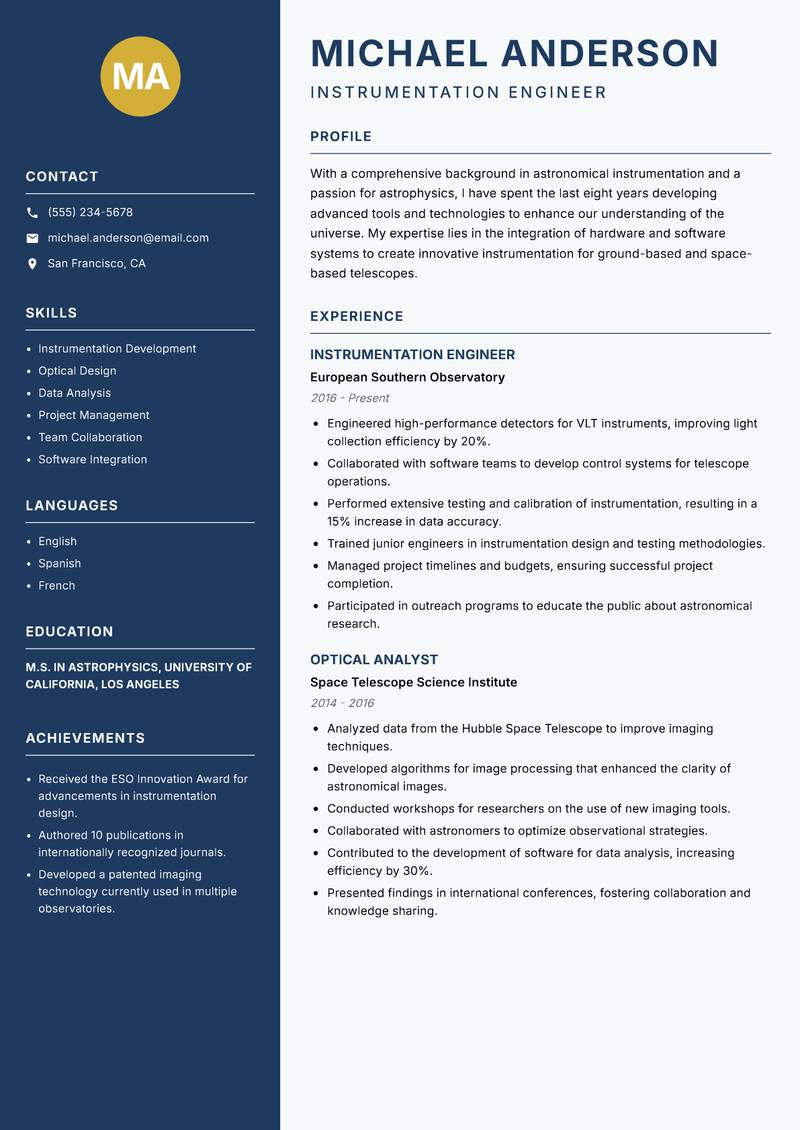
Instrumentation Engineer Resume

With a comprehensive background in astronomical instrumentation and a passion for astrophysics, I have spent the last eight years developing advanced tools and technologies to enhance our understanding of the universe. My expertise lies in the integration of hardware and software systems to create innovative instrumentation for ground-based and space-based telescopes. I have a proven record of leading cross-functional teams to deliver projects on time and within budget, while maintaining the highest standards of quality. My work includes designing and deploying detectors that have significantly increased sensitivity and resolution in astronomical observations. I thrive in collaborative environments, often working with physicists, engineers, and software developers to solve complex challenges. My commitment to ongoing education and professional development keeps me at the forefront of technological advancements in the field. I am eager to contribute my knowledge and skills to impactful projects that push the limits of astronomical research and discovery.

Instrumentation Development Optical Design Data Analysis Project Management Team Collaboration Software Integration
  1. Engineered high-performance detectors for VLT instruments, improving light collection efficiency by 20%.
  2. Collaborated with software teams to develop control systems for telescope operations.
  3. Performed extensive testing and calibration of instrumentation, resulting in a 15% increase in data accuracy.
  4. Trained junior engineers in instrumentation design and testing methodologies.
  5. Managed project timelines and budgets, ensuring successful project completion.
  6. Participated in outreach programs to educate the public about astronomical research.
  1. Analyzed data from the Hubble Space Telescope to improve imaging techniques.
  2. Developed algorithms for image processing that enhanced the clarity of astronomical images.
  3. Conducted workshops for researchers on the use of new imaging tools.
  4. Collaborated with astronomers to optimize observational strategies.
  5. Contributed to the development of software for data analysis, increasing efficiency by 30%.
  6. Presented findings in international conferences, fostering collaboration and knowledge sharing.

Achievements

  • Received the ESO Innovation Award for advancements in instrumentation design.
  • Authored 10 publications in internationally recognized journals.
  • Developed a patented imaging technology currently used in multiple observatories.
⏱️
Experience
2-5 Years
📅
Level
Mid Level
🎓
Education
M.S. in Astrophysics, Universi...

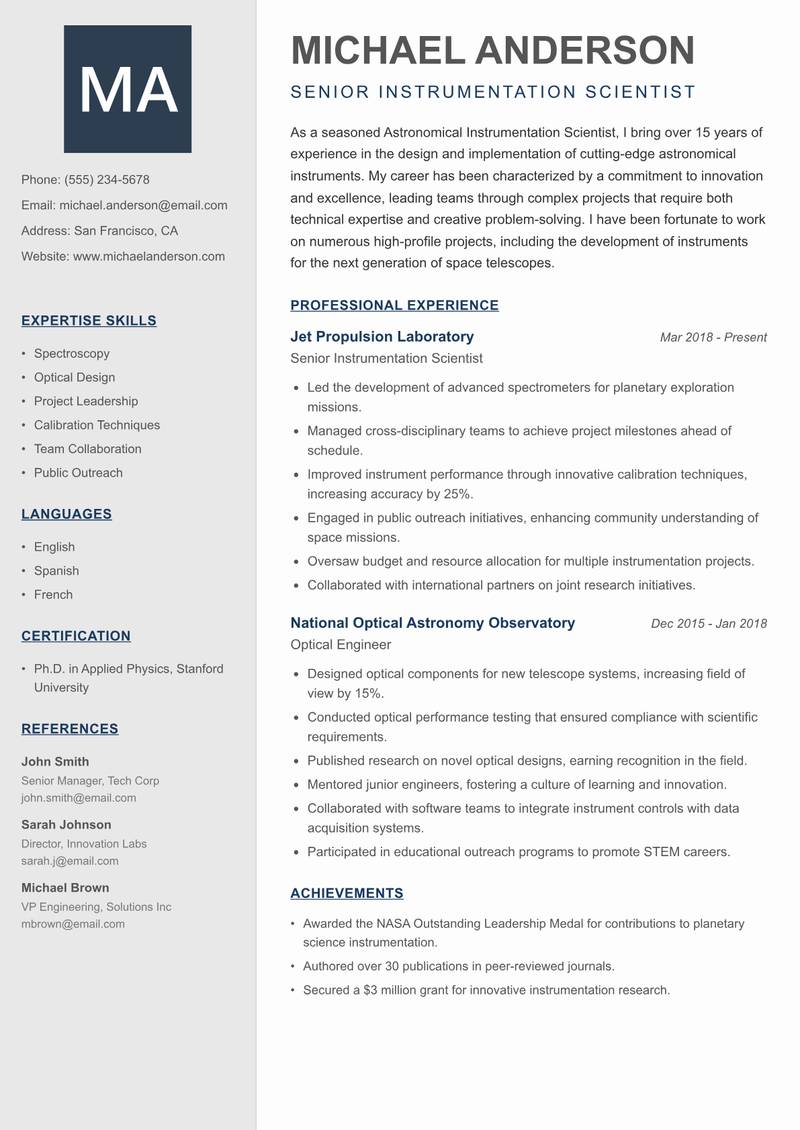
Senior Instrumentation Scientist Resume

As a seasoned Astronomical Instrumentation Scientist, I bring over 15 years of experience in the design and implementation of cutting-edge astronomical instruments. My career has been characterized by a commitment to innovation and excellence, leading teams through complex projects that require both technical expertise and creative problem-solving. I have been fortunate to work on numerous high-profile projects, including the development of instruments for the next generation of space telescopes. My strong analytical skills and attention to detail have enabled me to contribute to advancements in photonics and detector technologies, ultimately enhancing the capabilities of astronomical observations. I am passionate about translating scientific requirements into practical engineering solutions, fostering collaboration among diverse stakeholders, and mentoring emerging scientists in the field. My extensive experience in project management allows me to ensure that projects are completed on time and within budget, while adhering to the highest standards of quality and safety. I am eager to continue my professional journey by tackling new challenges and contributing to groundbreaking discoveries in astronomy.

Spectroscopy Optical Design Project Leadership Calibration Techniques Team Collaboration Public Outreach
  1. Led the development of advanced spectrometers for planetary exploration missions.
  2. Managed cross-disciplinary teams to achieve project milestones ahead of schedule.
  3. Improved instrument performance through innovative calibration techniques, increasing accuracy by 25%.
  4. Engaged in public outreach initiatives, enhancing community understanding of space missions.
  5. Oversaw budget and resource allocation for multiple instrumentation projects.
  6. Collaborated with international partners on joint research initiatives.
  1. Designed optical components for new telescope systems, increasing field of view by 15%.
  2. Conducted optical performance testing that ensured compliance with scientific requirements.
  3. Published research on novel optical designs, earning recognition in the field.
  4. Mentored junior engineers, fostering a culture of learning and innovation.
  5. Collaborated with software teams to integrate instrument controls with data acquisition systems.
  6. Participated in educational outreach programs to promote STEM careers.

Achievements

  • Awarded the NASA Outstanding Leadership Medal for contributions to planetary science instrumentation.
  • Authored over 30 publications in peer-reviewed journals.
  • Secured a $3 million grant for innovative instrumentation research.
⏱️
Experience
2-5 Years
📅
Level
Mid Level
🎓
Education
Ph.D. in Applied Physics, Stan...

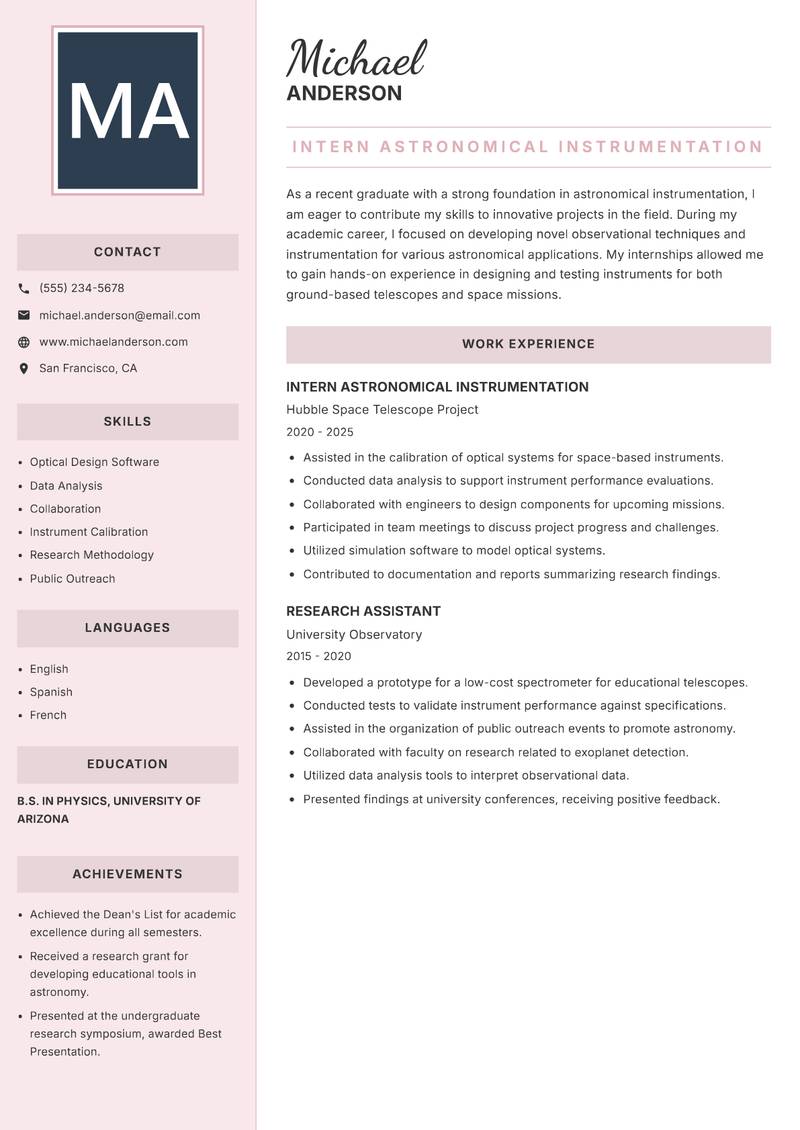
Intern Astronomical Instrumentation Resume

As a recent graduate with a strong foundation in astronomical instrumentation, I am eager to contribute my skills to innovative projects in the field. During my academic career, I focused on developing novel observational techniques and instrumentation for various astronomical applications. My internships allowed me to gain hands-on experience in designing and testing instruments for both ground-based telescopes and space missions. I excel in environments that require collaboration and creativity, often engaging with peers and mentors to solve complex problems. My technical skills include proficiency in optical design software and data analysis tools, which I utilized to conduct research projects during my studies. I am passionate about furthering my understanding of the universe and committed to pursuing a career in astronomical research and instrumentation. I am looking forward to applying my educational background and enthusiasm for science to a dynamic team where I can contribute to groundbreaking discoveries.

Optical Design Software Data Analysis Collaboration Instrument Calibration Research Methodology Public Outreach
  1. Assisted in the calibration of optical systems for space-based instruments.
  2. Conducted data analysis to support instrument performance evaluations.
  3. Collaborated with engineers to design components for upcoming missions.
  4. Participated in team meetings to discuss project progress and challenges.
  5. Utilized simulation software to model optical systems.
  6. Contributed to documentation and reports summarizing research findings.
  1. Developed a prototype for a low-cost spectrometer for educational telescopes.
  2. Conducted tests to validate instrument performance against specifications.
  3. Assisted in the organization of public outreach events to promote astronomy.
  4. Collaborated with faculty on research related to exoplanet detection.
  5. Utilized data analysis tools to interpret observational data.
  6. Presented findings at university conferences, receiving positive feedback.

Achievements

  • Achieved the Dean's List for academic excellence during all semesters.
  • Received a research grant for developing educational tools in astronomy.
  • Presented at the undergraduate research symposium, awarded Best Presentation.
⏱️
Experience
2-5 Years
📅
Level
Mid Level
🎓
Education
B.S. in Physics, University of...

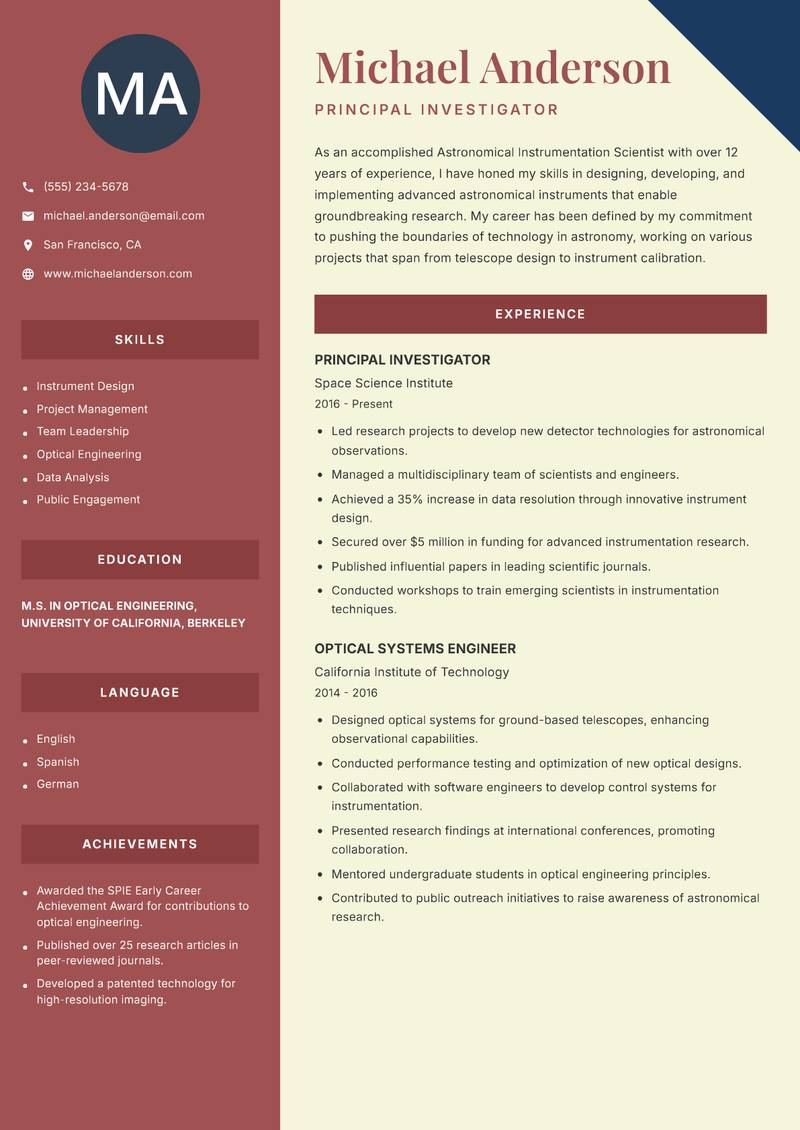
Principal Investigator Resume

As an accomplished Astronomical Instrumentation Scientist with over 12 years of experience, I have honed my skills in designing, developing, and implementing advanced astronomical instruments that enable groundbreaking research. My career has been defined by my commitment to pushing the boundaries of technology in astronomy, working on various projects that span from telescope design to instrument calibration. I have a deep understanding of the interplay between hardware and software, allowing me to create integrated solutions that enhance observational capabilities. My ability to lead teams and manage projects has resulted in successful outcomes, often exceeding performance expectations. I am particularly proud of my contributions to instrumentation for space-based observatories, where I have played a key role in the development of sensitive detectors and data acquisition systems. I am passionate about advancing the field through collaboration and innovation, and I look forward to leveraging my expertise to tackle the challenges of future astronomical research.

Instrument Design Project Management Team Leadership Optical Engineering Data Analysis Public Engagement
  1. Led research projects to develop new detector technologies for astronomical observations.
  2. Managed a multidisciplinary team of scientists and engineers.
  3. Achieved a 35% increase in data resolution through innovative instrument design.
  4. Secured over $5 million in funding for advanced instrumentation research.
  5. Published influential papers in leading scientific journals.
  6. Conducted workshops to train emerging scientists in instrumentation techniques.
  1. Designed optical systems for ground-based telescopes, enhancing observational capabilities.
  2. Conducted performance testing and optimization of new optical designs.
  3. Collaborated with software engineers to develop control systems for instrumentation.
  4. Presented research findings at international conferences, promoting collaboration.
  5. Mentored undergraduate students in optical engineering principles.
  6. Contributed to public outreach initiatives to raise awareness of astronomical research.

Achievements

  • Awarded the SPIE Early Career Achievement Award for contributions to optical engineering.
  • Published over 25 research articles in peer-reviewed journals.
  • Developed a patented technology for high-resolution imaging.
⏱️
Experience
2-5 Years
📅
Level
Mid Level
🎓
Education
M.S. in Optical Engineering, U...

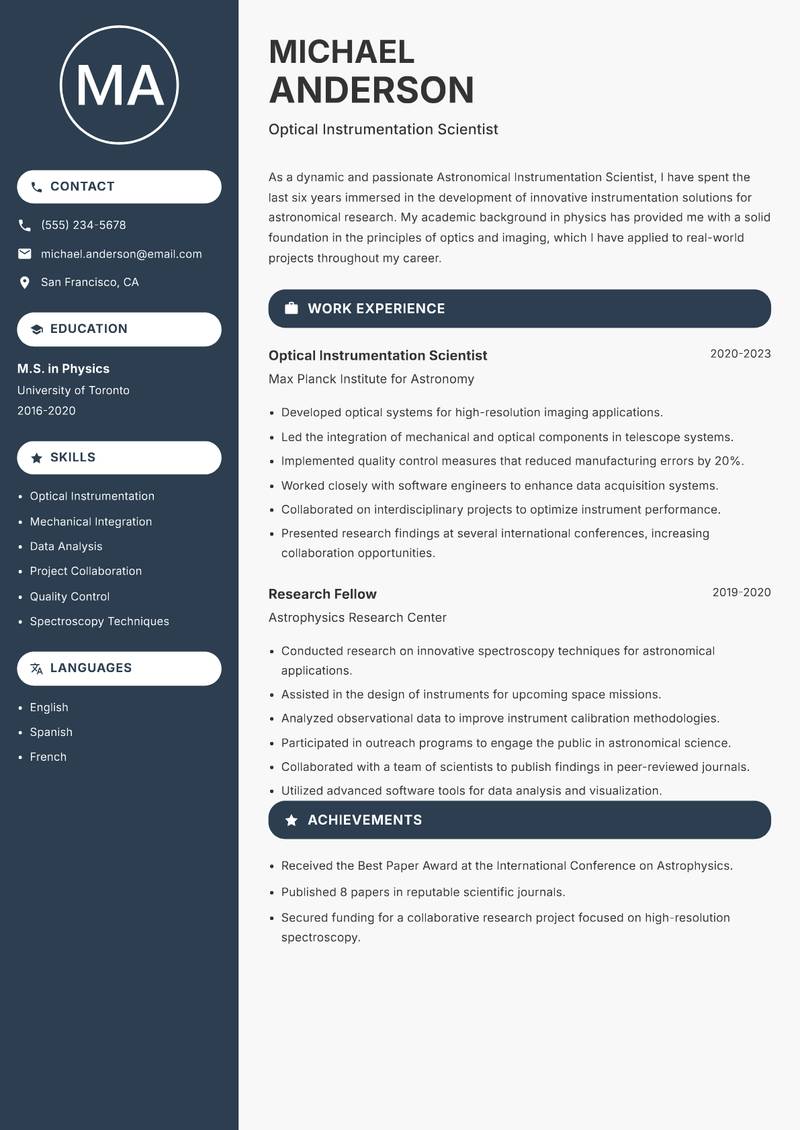
Optical Instrumentation Scientist Resume

As a dynamic and passionate Astronomical Instrumentation Scientist, I have spent the last six years immersed in the development of innovative instrumentation solutions for astronomical research. My academic background in physics has provided me with a solid foundation in the principles of optics and imaging, which I have applied to real-world projects throughout my career. I have experience in various aspects of instrument design, including optical layout, mechanical integration, and software development. My work has enabled significant advancements in the performance of astronomical instruments, allowing for deeper insights into the cosmos. I thrive in fast-paced, collaborative environments where creativity and critical thinking are essential. My goal is to continue developing state-of-the-art instruments that will help scientists unlock the mysteries of the universe. I am particularly interested in projects that involve high-resolution imaging and spectroscopy, as I believe these areas hold the key to many astronomical discoveries.

Optical Instrumentation Mechanical Integration Data Analysis Project Collaboration Quality Control Spectroscopy Techniques
  1. Developed optical systems for high-resolution imaging applications.
  2. Led the integration of mechanical and optical components in telescope systems.
  3. Implemented quality control measures that reduced manufacturing errors by 20%.
  4. Worked closely with software engineers to enhance data acquisition systems.
  5. Collaborated on interdisciplinary projects to optimize instrument performance.
  6. Presented research findings at several international conferences, increasing collaboration opportunities.
  1. Conducted research on innovative spectroscopy techniques for astronomical applications.
  2. Assisted in the design of instruments for upcoming space missions.
  3. Analyzed observational data to improve instrument calibration methodologies.
  4. Participated in outreach programs to engage the public in astronomical science.
  5. Collaborated with a team of scientists to publish findings in peer-reviewed journals.
  6. Utilized advanced software tools for data analysis and visualization.

Achievements

  • Received the Best Paper Award at the International Conference on Astrophysics.
  • Published 8 papers in reputable scientific journals.
  • Secured funding for a collaborative research project focused on high-resolution spectroscopy.
⏱️
Experience
2-5 Years
📅
Level
Mid Level
🎓
Education
M.S. in Physics, University of...

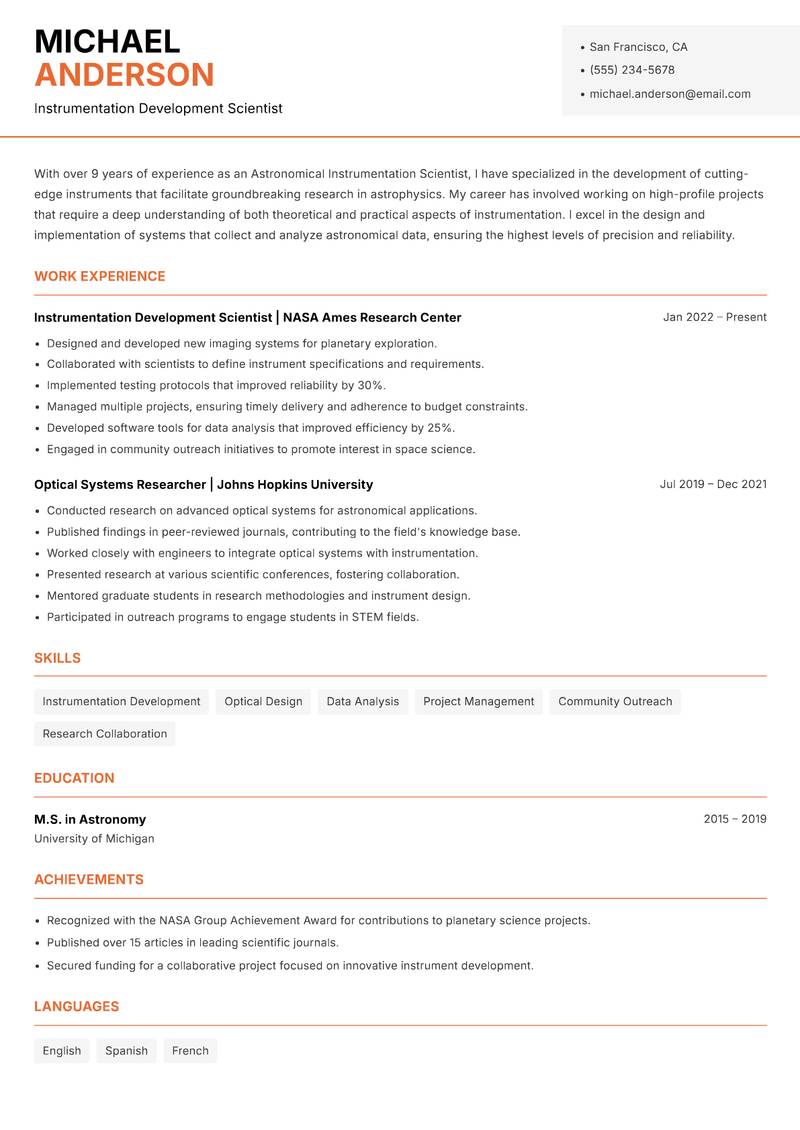
Instrumentation Development Scientist Resume

With over 9 years of experience as an Astronomical Instrumentation Scientist, I have specialized in the development of cutting-edge instruments that facilitate groundbreaking research in astrophysics. My career has involved working on high-profile projects that require a deep understanding of both theoretical and practical aspects of instrumentation. I excel in the design and implementation of systems that collect and analyze astronomical data, ensuring the highest levels of precision and reliability. My work has played a crucial role in enhancing our ability to observe celestial phenomena, and I have a proven track record of successfully managing complex projects from conception to completion. I am passionate about advancing technology in astronomy and collaborating with fellow scientists to explore the universe's mysteries. I thrive in environments that encourage innovation and creativity, and I am eager to contribute my expertise to new projects that challenge the status quo and push the boundaries of what is possible in astronomical research.

Instrumentation Development Optical Design Data Analysis Project Management Community Outreach Research Collaboration
  1. Designed and developed new imaging systems for planetary exploration.
  2. Collaborated with scientists to define instrument specifications and requirements.
  3. Implemented testing protocols that improved reliability by 30%.
  4. Managed multiple projects, ensuring timely delivery and adherence to budget constraints.
  5. Developed software tools for data analysis that improved efficiency by 25%.
  6. Engaged in community outreach initiatives to promote interest in space science.
  1. Conducted research on advanced optical systems for astronomical applications.
  2. Published findings in peer-reviewed journals, contributing to the field's knowledge base.
  3. Worked closely with engineers to integrate optical systems with instrumentation.
  4. Presented research at various scientific conferences, fostering collaboration.
  5. Mentored graduate students in research methodologies and instrument design.
  6. Participated in outreach programs to engage students in STEM fields.

Achievements

  • Recognized with the NASA Group Achievement Award for contributions to planetary science projects.
  • Published over 15 articles in leading scientific journals.
  • Secured funding for a collaborative project focused on innovative instrument development.
⏱️
Experience
2-5 Years
📅
Level
Mid Level
🎓
Education
M.S. in Astronomy, University ...

Key Skills for Astronomical Instrumentation Scientist Positions

Successful astronomical instrumentation scientist professionals typically possess a combination of technical expertise, soft skills, and industry knowledge. Common skills include problem-solving abilities, attention to detail, communication skills, and proficiency in relevant tools and technologies specific to the role.

Typical Responsibilities

Astronomical Instrumentation Scientist roles often involve a range of responsibilities that may include project management, collaboration with cross-functional teams, meeting deadlines, maintaining quality standards, and contributing to organizational goals. Specific duties vary by company and seniority level.

Resume Tips for Astronomical Instrumentation Scientist Applications

ATS Optimization

Applicant Tracking Systems (ATS) scan resumes for keywords and formatting. To optimize your astronomical instrumentation scientist resume for ATS:

Frequently Asked Questions

How do I customize this astronomical instrumentation scientist resume template?

You can customize this resume template by replacing the placeholder content with your own information. Update the professional summary, work experience, education, and skills sections to match your background. Ensure all dates, company names, and achievements are accurate and relevant to your career history.

Is this astronomical instrumentation scientist resume template ATS-friendly?

Yes, this resume template is designed to be ATS-friendly. It uses standard section headings, clear formatting, and avoids complex graphics or tables that can confuse applicant tracking systems. The structure follows best practices for ATS compatibility, making it easier for your resume to be parsed correctly by automated systems.

What is the ideal length for a astronomical instrumentation scientist resume?

For most astronomical instrumentation scientist positions, a one to two-page resume is ideal. Entry-level candidates should aim for one page, while experienced professionals with extensive work history may use two pages. Focus on the most relevant and recent experience, and ensure every section adds value to your application.

How should I format my astronomical instrumentation scientist resume for best results?

Use a clean, professional format with consistent fonts and spacing. Include standard sections such as Contact Information, Professional Summary, Work Experience, Education, and Skills. Use bullet points for easy scanning, and ensure your contact information is clearly visible at the top. Save your resume as a PDF to preserve formatting across different devices and systems.

Can I use this template for different astronomical instrumentation scientist job applications?

Yes, you can use this template as a base for multiple applications. However, it's recommended to tailor your resume for each specific job posting. Review the job description carefully and incorporate relevant keywords, skills, and experiences that match the requirements. Customizing your resume for each application increases your chances of passing ATS filters and catching the attention of hiring managers.

Scroll to view samples